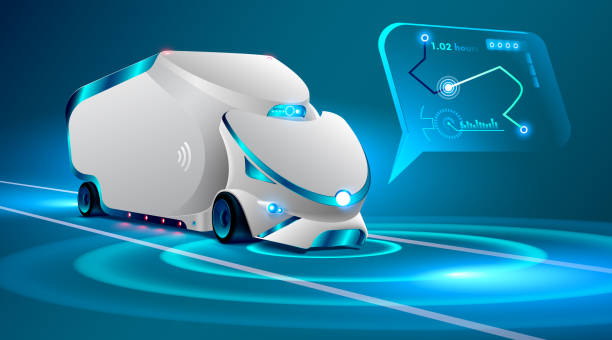
A spacecraft autonomously exploring the outer reaches of the cosmos descends through atmosphere from a distant exoplanet. This environment is unknown to the robotic vehicle and its programmers.
How can the spacecraft navigate with so much uncertainty?
Researchers at MIT have created a new method that could allow the spacecraft to land safely. The new technique can allow an autonomous vehicle to chart a safe course in highly uncertain environments, where both the environmental conditions and objects it could collide with are unknown.
This technique can even be used to help vehicles navigate around obstacles that change shape and move in unpredictable ways. The technique plots a safe route to a target area even if the vehicle’s exact starting point is unknown or when it is uncertain how the vehicle will move due environmental disturbances such as wind, ocean currents, and rough terrain.
This technique is the first to address the problem of trajectory plan with multiple simultaneous uncertainties and complex safety constraints. Weiqiao, a graduate student at the Department of Electrical Engineering and Computer Science and Computer Science and Artificial Intelligence Laboratory, co-lead author, said that this is the first time such a technique has been developed.
Future robotic space missions will require risk-aware autonomy in order to explore remote and extreme planets where there is no prior knowledge. This requires trajectory-planning algorithms that can reason about uncertainties, deal with complex uncertain models, and avoid safety constraints.” Ashkan Jasour is a co-lead author and a former CSAIL researcher scientist. He now works at NASA Jet Propulsion Laboratory (JPL) on robotics systems.
Senior author Brian Williams, a professor of aeronautics/astronautics and CSAIL member, will be joining Han and Jasour in the paper. The paper will be presented at IEEE International Conference on Robotics and Automation. It has been nominated to receive the Outstanding Paper Award.
Avoid Assumptions
This trajectory planning problem is so complicated that other methods of finding a safe route forward assume certain assumptions about the vehicle, obstacles, environment, and people. Jasour states that these methods are too simple to be applied in real-world situations and cannot guarantee safe trajectories in the face of uncertain safety constraints.
Han notes that this uncertainty could be caused by the randomness or inaccuracy of the perception system of an autonomous vehicle.
The algorithm developed probabilities about how likely it was to observe different obstacles and environmental conditions at different locations. These computations would be made using images or a map of the environment that the robot’s perception system provided.
Their algorithms are able to formulate trajectory planning using this approach. It is a probabilistic optimization problem. This framework is a mathematical programming framework which allows the robot achieve planning objectives such as maximising velocity or minimizing fuel use, while also considering safety constraints such as avoiding hazards. Jasour stated that the probabilistic algorithms they created reason about risk. This is the probability of not meeting those safety constraints or planning objectives.
This probabilistic optimization problem is too complicated to solve using standard methods because it involves multiple uncertain models and constraints. These include the location and form of each obstacle, as well as the starting location and the behavior of the robot. Researchers used higher-order statistics to calculate probabilities of the uncertainties in order to transform that probabilistic optimization into an easier, more deterministic optimization problem. This can be done efficiently using existing off-the shelf solvers.
“Our challenge was to reduce the size and to consider more practical constraints in order to make it work. Jasour states that it took a lot to go from good theory into good application.
The optimization solver creates a risk-bounded path. This means that, if the robot follows this path, there is a 1% chance it will run into any obstacles. They then generate a series of control inputs that will allow the vehicle to safely reach its target area.
Charting Courses
The technique was evaluated using several simulations of navigation. One was an underwater vehicle that charted a course around an uncertain area and around some strangely-shaped obstacles to reach a destination. It reached the goal safely at least 99 percent of its time. It was also used to create a safe path for an aircraft that avoided 3D flying objects of uncertain sizes and positions. The vehicle could still move in spite of strong winds and other factors. Their system enabled the aircraft to reach its destination with high probability.
The algorithms took between a couple of seconds and a couple of minutes depending on the complexity in the environment to create a safe trajectory.
Jasour states that the researchers are currently working on faster processes to reduce runtime, which could help them get closer to real time planning scenarios.
Han is also working on feedback controllers that would be applied to the system. This would allow the vehicle to follow its intended trajectory even when it diverges from the ideal course. Han is also developing a hardware implementation to allow the researchers to demonstrate their method in a robot.