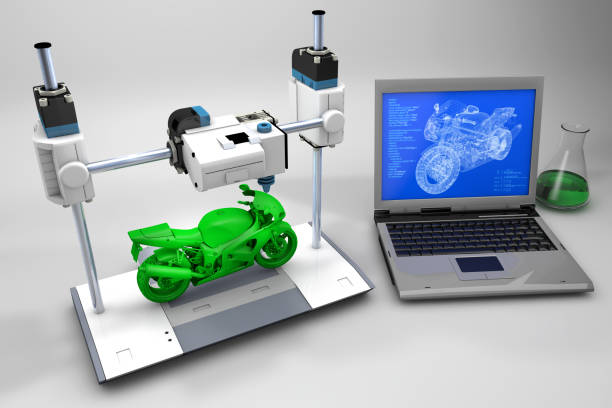
According to a new study in the journal Science, researchers at the University of California, Berkeley discovered a faster way to 3D print glass microstructures. This produces objects with better optical quality, design flexibility and strength.
The researchers collaborated with scientists from the Albert Ludwig University of Freiburg, Germany to extend the capabilities of the 3D-printing process that they developed three year ago — computed alpha lithography (CAL), to print finer features and in glass. This new system was called “micro-CAL”.
Glass is often used to create complex microscopic objects. This includes lenses for compact, high-quality cameras such as endoscopes and smartphones, as well microfluidic devices that analyze and process tiny amounts of liquid. Unfortunately, current manufacturing processes are slow, costly, and limited in their ability meet industry demands.
The CAL process is fundamentally distinct from industrial 3D printing manufacturing processes. These processes build objects from thin layers. This method can take a lot of time and produce a rough surface texture. However, CAL 3D-prints all of the object at once. Researchers use a laser to project light patterns into a rotating volume light-sensitive material. This creates a 3D light dose which then solidifies into the desired shape. Complex geometries and smooth surfaces can be achieved thanks to the CAL process’s lack of layers.
This study expands the capabilities of CAL to print microscale details in glass structures. Hayden Taylor, principal investigator at UC Berkeley and professor of mechanical engineering, said that CAL was able to print microscale features into polymers when we published the method in 2019.
“Now, micro-CAL allows us to print objects in polymers down to 20 millionths (or about a quarter of the width of a human hair) with features as small as a meter. This method can be used to print into polymers and glass for features as low as 50 millionths.
Taylor and his research team worked with scientists at the Albert Ludwig University in Freiburg to create the special resin material that contains nanoparticles made of glass. The binder liquid is light-sensitive. The binder is solidified by digital light projections. Researchers heat the object to melt the binder.
Taylor stated that “the key enabler is that the binder’s refractive index is almost identical to the glass so light passes through it with virtually no scattering.” “The CAL printing process is perfect for this Glassomer [GmbH] material.
Joseph Toombs, a Ph.D. candidate in Taylor’s laboratory, was the lead author of the research. He also conducted tests that showed that CAL-printed glass objects were more durable than those printed using a layer-based process. Taylor stated that glass objects break more easily if they have more cracks or flaws than others or have rough surfaces. “CAL’s ability create objects with smoother surfaces, than other layer-based 3D printing processes is a huge advantage.
Manufacturers of microscopic glass objects have a new, more efficient way to satisfy customers’ demands for size, geometry, optical and mechanical properties. This includes microscopic optical components that are key parts of advanced microscopes, compact cameras and other scientific instruments. Taylor stated that being able to produce these components more quickly and with greater geometric freedom could lead to new functions for devices or lower-cost products.