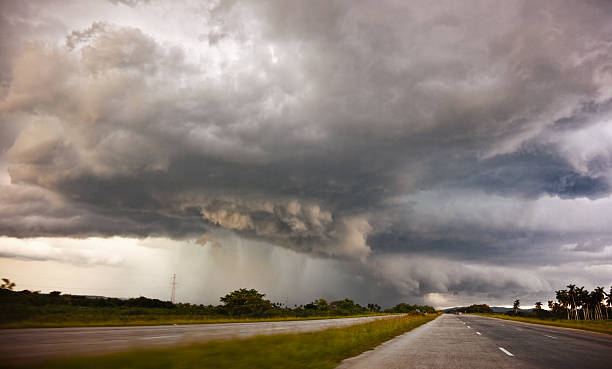
Although scientists are reluctant to attribute climate change, varying weather conditions are creating new and disturbing tornado patterns.
A flurry tornadoes has caused widespread destruction in the US. A tornado that ripped through southeastern Missouri on Wednesday killed at least five people. It was the second tornado to strike Missouri in a row, following six from New Jersey. Over the weekend, more than 30 people were killed by tornadoes in the South and Midwest. In January, 168 preliminary tornado report were received, almost five times the average monthly number between 1990 and 2010.
It has been a chaotic start to tornado season. The twisters have struck areas that are usually not affected. We know that the warming climate causes moisture and instability in the atmosphere, which are two factors that can lead to tornadoes. Experts warn that it is too early to link one major event or even a season with climate change. They are seeing changes in the timing and location of tornadoes, which could increase the risk for more people.
Jana Houser, an Ohio State University professor of meteorology, says that “we are still very uncertain what the future holds.” Meteorologists can examine changes in the jet stream and increased humidity to see how these may impact the tornado-producing storms. Houser said that it is impossible to predict when or where tornadoes will occur.
The majority of tornadoes are the result of rare supercell thunderstorms. Tornadoes require moist, warm air close to the ground in order to form. They also require strong vertical wind shear. This is due to wind speed and direction changing between higher elevations and the ground. The air begins to spin horizontally, creating a cylinder-like form. It lifts up and speeds up, forming the funnel we know as a tornado.
Meteorologists look at the trends in supercell storms to understand how tornado patterns may change. Increased heat levels in the atmosphere can lead to increased instability and moisture. Wind shear, another component of a tornado may decrease with climate change. As the temperature differences between Arctic air and mid-latitude air decrease, the jet stream could become weaker. This will affect wind shear. It is not clear what the end result of these changes in the atmosphere will be.
Walker Ashley, a Northern Illinois University professor of meteorology who has written a paper about changing tornado patterns, said that “we’re in the experiment.” We are seeing changes in the basic ingredients that create severe storms. It is a matter of how big and small.
Experts believe supercell storms are likely to hit the US more frequently in the late winter, early spring, and less often in the fall and summer. Tornado territory is also changing. “Tornado Alley” is a large area that includes parts of Texas and Louisiana as well as Oklahoma, Kansas, South Dakota and Iowa. It has been a hotbed for twisters since long. Robert Trapp, professor at the University of Illinois at UrbanaChampaign, said that drought conditions are causing fewer storms.
It is more difficult to connect climate change with tornadoes than for other catastrophic weather like heat waves and hurricanes. Tornadoes, on the other hand, are smaller-scale events. The US National Weather Service began recording tornadoes only in 1950. Many have been missed in areas that are not populated. The National Oceanic and Atmospheric Administration data shows that while the number of tornadoes per year has decreased, there is more tornado activity on those days when they do occur.
Records also reveal that tornadoes can be unpredictable–some years, they kill between 10 and 20 people in the US. Some tornadoes claim more than 100 lives. However, overall, the number deaths per thousand people has declined over time.
Their power to destroy might increase for one simple reason: They have more people to kill. Since 1950, the US population has increased by more than two-thirds. Real estate development has been very popular in the Southeast, which could see more tornado activity. Ashley refers to this as the “bull’s-eye effect”. As communities grow, so will tornado activity. More tornadoes could cause more destruction in the off-season, and in new areas.