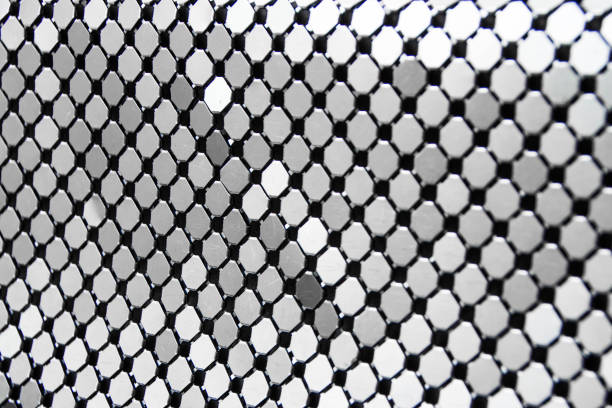
Caltech engineers and JPL scientists have created a material inspired by chain mail. It can be transformed from fluid-like to specific solid shapes under pressure.
According to Chiara Daraio (Caltech’s G. Bradford Jones Professor in Mechanical Engineering and corresponding author on a study that described the material, which was published in Nature August 11, this material could have potential uses as an intelligent fabric for exoskeletons or as an adaptive cast that adjusts it stiffness as injuries heal.
Daraio states that they wanted materials that could change their stiffness at will. Daraio says, “We wanted to make a fabric that can change stiffness on command.” An excellent example of this is Batman’s cape in Batman Begins. It’s flexible but rigid when the Caped Crusader needs to be a gliding surface.
Daraio points out that materials with similar properties exist all around us. Think about coffee in a vacuum-sealed package. It is still solid when it is sealed, which we call “jamming.” But once you open the bag, the coffee grounds will no longer be pressed against each other, and you can pour them like fluid.
Coffee grounds and sand particles are complex, distinct, and jammed when compressed. However, sheets of linked rings can stop under tension-compression (when pulled apart or pushed together) Daraio states, “That’s it.” “We tried a variety of particles to determine which ones were flexible and stiff. The ones that jammed under only one stress performed poorly.”
Daraio and Yifan Wang, a former Caltech postdoctoral researcher, and Liuchi Li (PhD’19) were co-lead writers of the Nature papers. They designed many configurations of linked particles, from linking rings to linking cubes to linking octahedrons, which look like two pyramids connected at their base. Douglas Hofmann (Caltech’s principal scientist at JPL) helped to 3-D print the materials. These configurations were then replicated in a computer using a model created by Jose E. Andrade (George W. Housner Professor in Civil and Mechanical Engineering and Caltech resident expert in modeling granular materials).
“Granular materials can be an excellent example of complex systems. Simple interactions at the grain scale can lead to structurally too complex behavior. The ability to carry tensile loads at a grain scale in chain mail is a game changer. It’s similar to having a string capable of carrying compressive loads. Andrade says the ability to model complex behavior allows for extraordinary structural design and performance.
Engineers applied outside stress to the fabric by compressing it using a vacuum chamber or dropping weight to reduce the material’s jamming. One experiment showed that a vacuum-locked, chain mail fabric could support 1.5 kilograms of load, more than 50 times its weight. Fabrics with a more significant average number of contact between particles (e.g., linked rings or squares) showed the most critical variations in mechanical properties (from flexible and stiff to relaxed).
Wang is now an assistant professor at Nanyang Technological University, Singapore.
Daraio imagines running cables through the material to create a bridge that can be unrolled and driven across. She says that these cables are like drawstrings on a hoodie.
Parallel work was done on intelligent surfaces. These surfaces can change their shape to suit specific situations. Daraio and Ke Liu, a postdoctoral scholar, and Felix Hacker, a visiting student, recently demonstrated a method of controlling the surface’s shape. They embedded networks of heat-responsive liquid crystal elastomers (LCEs), thin strips of polymer that shrink when heated. These LCEs are equipped with stretchable heating coils, which an electrical current can charge. This warms them and causes their contraction. The LCEs began to contract by tugging at the flexible material they were embedded in and compressing it into a pre-designed solid shape.
This work was published in the journal Science Robotics on April 7. It could be used for remote collaboration, where a physical component is required, medical devices, or haptics (which use technology that simulates physical sensations for virtual reality). The team will next work to optimize and miniaturize the design of structured fabrics and intelligent systems to make them more practical.