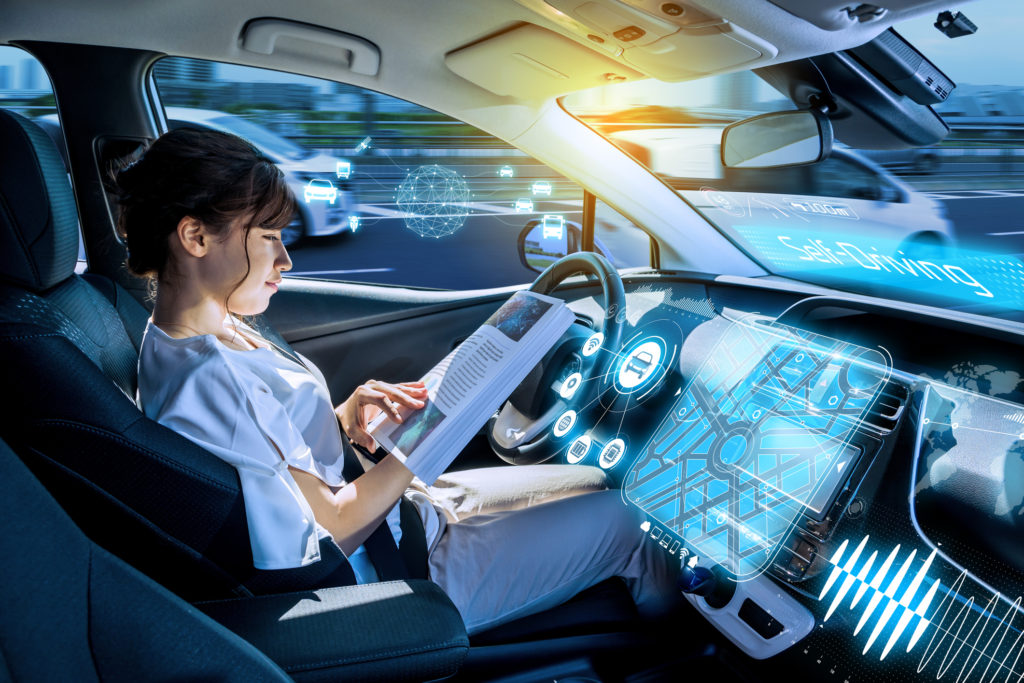
Self-driving is the autonomous driving of a vehicle between two locations without the assistance of a human driver. Google, Uber and Tesla have all developed self-driving technology in recent years. Self-driving technology, although still in its infancy and potentially transforming our transportation system, is becoming more common. To achieve its goals, an autonomous vehicle must understand its surroundings, plan the route, and make accurate judgments when interfacing with other objects.
It relies on these key technologies to accomplish this feat.
Front Camera- A camera mounted on the windshield allows the car to see objects in front. This camera records and detects information about traffic signs and lights and is intelligently interpreted and interpreted by the software. The camera is the vehicle’s eye through which it perceives the world.
Ultrasonic Sensors
Ultrasonic sensors are placed on the rear wheels to keep the car’s movements in check and alert it about obstacles. To track the distance and relative velocity of the car and other stationary or non-stationary objects, it uses the doppler effect.
LIDAR
The autonomous car drives along the route, and then maps the route, including road signs, poles, markers and other road conditions. This map is fed into car’s software, allowing it to identify which part of the road is regular. LIDAR creates a 3D map of the environment as the car moves. This map is used to semantic segmentation, which involves the description of objects in every pixel of an image. LIDAR’s use is controversial. Some researchers suggest that it could be replaced by two cameras, each with a different angle to capture a perspective view of the vehicle from the front. LIDAR can be quite costly so this could lead to a decrease in the prices.
Aerial –
An aerial mounted on the back of the vehicle collects data about the exact location of the car. The sensors and the GPS inertial navigation system of the car work together to help it locate itself. The vehicle’s internal map updates with new positional information as it moves. This helps the car to understand where it is at any given moment.
Computer Software-
This is the heartbeat of self-driving cars. It processes all data that is received from various sensors in real-time and acts based on it using various actuators. Computer software basically serves three functions: it processes the inputs, plots a path, and gives instructions to the actuators for controlling acceleration, braking, and steering. The advancements in processor processing power and accuracy of deep learning algorithms have made it possible to develop autonomous vehicle technology. The future landscape of transportation will likely change due to sensor fusion and advances in computer vision technology. Researchers believe that these vehicles will soon be commonplace on roads, even though there is still much to do.