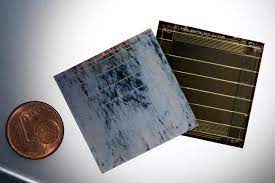
Perovskite solar cell efficiency has already exceeded 25 per cent in the laboratory. The initial materials and manufacturing processes for perovskite solar cells are much cheaper than silicon solar cells with similar efficiency. This has been, however, limited to a small scale. Professor Ulrich W. Paetzold, tenure track at KIT’s Institute of Microstructure Technology (IMT), says that this technology cannot be commercialized because it lacks stability and can be difficult to transfer high-efficiency levels from small to large scales. This is the precondition for developing cost-effective solar modules. This is a great opportunity as many modules could be integrated into buildings that are not yet used, such as facades. Cost efficiency and aesthetics are important factors in such applications. Paetzold’s team and industry partner SUNOVATION studied an inkjet process to colour perovskite solar panels. It has a benefit: Inkjet printing can be used to colour the modules on larger surfaces.
Colour Impression Is Independent Of Incident Light
This second advantage is the result of the chosen approach. “Until now, color impressions of colored perovskite sun cells has depended on the angle of incident light,” says Helge Eggers (IMT), project coordinator. Eggers says that the colour of our method is almost independent of the angle of incident solar radiation, and it always looks the same. Researchers proved that the same method used to produce silicon solar modules could be successfully applied to perovskite modules through a series of experiments. The efficiency of solar cells with colours such as yellow, magenta and cyan reached 60 per cent when they converted solar energy into electricity.
The marble looks thanks to the colour mix.
Third, inkjet printing allows for colour mixing. This allows for a broad range of colours and allows the printing of intricate colour patterns. Researchers created solar modules that resembled various building materials. Perovskite solar modules with white marble optics achieved high efficiency of as high as 14 per cent. “In the case of building-integrated solar photovoltaics, the module will replace the roof or facade and install the photovoltaic systems on the roof. Eggers states that this will save you money. “Building-integrated photovoltaics can be described as a solar cell with a low efficiency that is more efficient than a wall providing no power. A 14 per cent efficiency is huge in this regard.