Hand-held laser pointers do not produce any noticeable recoil forces even when they are “fired”. This is due to its large mass and the tiny recoil impulses the light particles create when they leave the laser pointeder.
It has been known for a long time that small particles can be affected by optical recoil forces. Light pressure is partly responsible for comet tails pointing away from the Sun. Also, the propulsion by light spacecraft via lightweight sails has been repeatedly discussed, most recently in relation to the “starshot” project in which a fleet miniature spacecraft will be sent to Alpha Centauri.
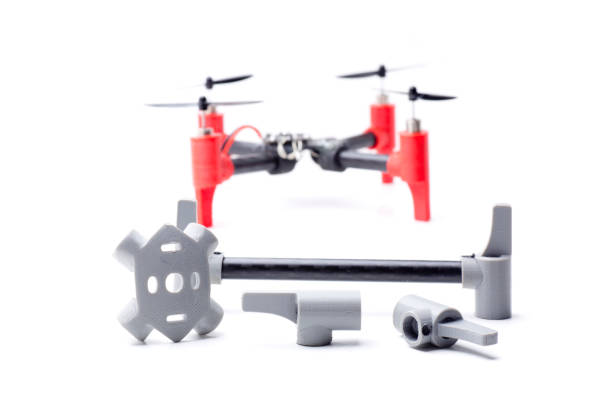
Models of quadcopter drones for everyday use
The journal Nature Nanotechnology reports that Wurzburg physicists, led by Professor Bert Hecht (Chair, Experimental Physics 5, Nano-Optics Group), have demonstrated for the first-time that it is possible not only to propel small objects in an aqueous environment with sunlight but also to control them on a surface with all three freedoms (two translational and one rotational).
They were inspired by quadcopter drones that have four independent rotors to control the movements. These control options offer new possibilities for handling the often difficult nano- and microobjects. They can be used for assembly, analysis, or reproduction medicine.
Polymer discs that can be equipped with up to four light-driven, nanomotors
A transparent polymer disc measuring 2.5 mm in diameter makes up the Wurzburg microdrones. This disc contains up to four nanomotors made from gold that can be independently addressed.
“These motors were based on optical antennas developed in Wurzburg – that is tiny metallic structures with dimensions less then the wavelength of the light,” says Xiaofei Wu (postdoc in the Hecht research team). These antennas are optimized to receive circularly polarised light. This allows motors to receive light regardless of drone orientation. It is critical for their applicability. The motor then emits the light energy it has received in an optical direction to create optical recoil force. This depends on whether the motor is rotating clockwise or counterclockwise and the wavelength of the light.
Only with this idea were the researchers able to control their microdrones effectively and precisely. Extreme accelerations are possible due to the drone’s small mass.
It was a challenging task to develop the microdrones. It all began in 2016, with a grant from the VW Foundation for research on risky projects.
Precision fabrication using single-crystal Gold
For the functioning of microdrones, it is essential to precisely fabricate the nanomotors. It has been a game-changer to use accelerated Helium Ions to create nanostructures out of monocrystalline gold. The drone body can be made using electron beam lithography. The drones should be removed from the substrate and placed in solution.
Further experiments will reveal how a feedback loop can be used to correct external influences to the microdrones and allow them to be controlled more precisely. The research team is also working to improve the control options in order to regulate the drones’ height above the ground. A second goal is attaching functional tools to microdrones.