Interferometers combine two or more sources of light to create interference patterns. These patterns can give remarkably detailed information about everything they illuminate. This includes a small flaw in a mirror to the dispersion and distribution of pollutants in the atmosphere to gravitational patterns far away in the Universe.
Jaime Cardenas, assistant professor of optics at Rochester University, says, “If you want something to be measured with extremely high precision, you almost always need an optical interferometer because light makes it a very precise ruler.”
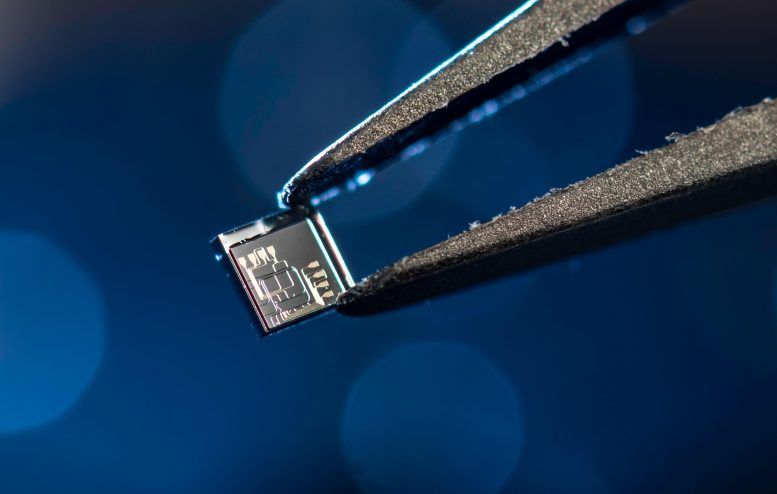
The Cardenas Lab now has a way to make these optical workers more efficient and sensitive. Meeting Song, a Ph.D. candidate, has packaged for the first time an experimental method of amplifying interferometric signal–without a corresponding rise in extraneous, undesirable input or “noise–on an integrated photonic chip measuring 2 mm by 2. This breakthrough is described in Nature Communications. It was based on Andrew Jordan’s theory of weak value amplification with waveguides, which he and his students developed.
Jordan and his team have been studying weak-value amplification for over a decade. Mode analysis was used in a new way to analyze free space interferometers with weak value amplifiers. This bridged the gap between waveguide weak-value amplification and free space. Therefore, they could demonstrate the theoretical feasibility of integrating weak-value amplification onto a photonic chip.
The weak value amplification technique gives you free amplification. Although it does cost power, it is almost free. Cardenas states that you can amplify the signal without adding noise, which is a huge deal.
Weak value amplification, based on quantum mechanics, involves only directing certain photons to a detector with the required information. This concept has been demonstrated previously, Cardenas explains. “But it’s always in a large setup with a table, several mirrors, laser systems, all very carefully aligned, all very painstakingly, and carefully aligned,” Cardenas adds. The interferometer can be attached to a chip to be placed on a rocket or helicopter. It will also fit in your phone and not get misaligned.
Song’s device is not like an interferometer. Song’s device uses a series of tilted mirrors that bend light to create an interference pattern. Instead, Song has included a waveguide designed to propagate an optical wavefront through the chip.
Cardenas states, “This is one the novelty of the paper.” “No one has ever really spoken about wavefront engineering using a photonicchip.”
Traditional interferometers can increase the signal-to-noise ratio, which results in more meaningful input. This is possible by increasing the laser power. Cardenas explains that there is a limit to this because traditional interferometers have a limited ability to handle laser power. Once saturated, the signal-to-noise ratio cannot be increased.
Song’s device eliminates this limitation by reaching the same interferometer signal using less light at the detectors. This leaves room for increasing the signal-to-noise ratio by adding laser power.
Cardenas states that Meeting will always have a higher signal-to-noise ratio if the detector absorbs the same power in its weak-value device. “This work is cool and subtle with a lot of physics engineering going on behind the scenes.”
The next steps include adapting the device to coherent communications and quantum applications using squeezed entangled photons. This will enable devices like quantum gyroscopes.