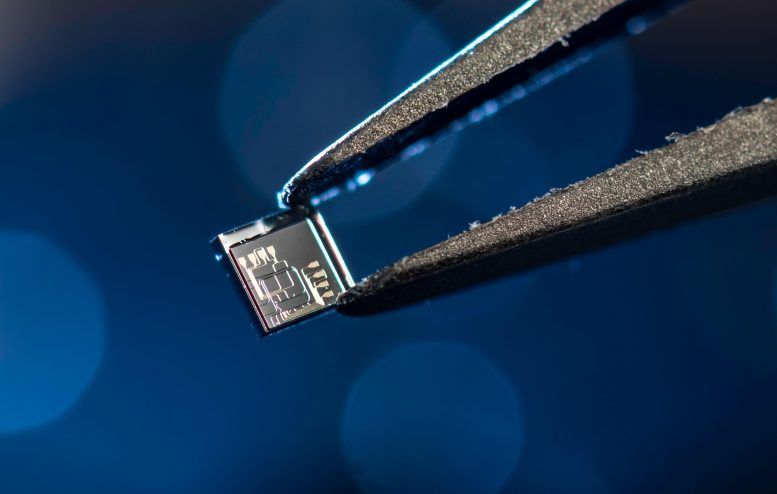
MIT researchers demonstrated that creating a quantum physics-based sensor that could detect the SARS virus using mathematical simulations is possible. Credit: Edited by MIT News.
Quantum Physics Sensor Could detect SARS-CoV-2 Virus.
Mathematical simulations suggest that the new method may be faster, more affordable, and more precise in detecting new variants.
The novel testing method for the COVID-19 virus may allow for faster and cheaper tests. It also makes it less likely that errors can be made. The researchers believe these detectors can be modified to detect any virus, even though the research is still theoretical.
The new approach was described in a paper published on December 16, 2021, in the journal Nano Letters by Changhao Li (a doctoral student at MIT); Paola Cappellaro (a professor of nuclear science, engineering, and physics; and Rouholla Suleyman and Mohammad Kohandel from the University of Waterloo.
There are two types of tests available for the virus. One is a rapid test that detects specific viral proteins, and another takes several hours to process. These tests cannot accurately quantify the virus’s presence. Even the most reliable PCR tests could experience false-negative rates exceeding 25%. The team found that the new test may have less than 1 percent false negative rates. It could detect as few as 100 strands of viral RNA in seconds.
Researchers claim that the sensor is made from low-cost materials. The diamonds used are less than specks in dust and can be scaled up to analyze a whole batch of samples simultaneously. Credit: The researchers
This new approach uses atomic-scale defects in small bits of diamond known as nitrogen-vacancy centers. These small defects are sensitive to minor perturbations due to quantum effects in the crystal lattice of a diamond. They are being investigated for sensing devices with high sensitivity.
This new method involves coating nanodiamonds containing these NV centers with a magnetically coupled material and treating it to only bond with the virus’s specific RNA sequence. The virus RNA attaches to the material and disrupts the magnetic link. This causes the diamond’s fluorescence to change, which can be easily detected using a laser-based optical scanner.
Researchers claim that the sensor is made from low-cost materials. The diamonds used are less than specks in dust and can be scaled up to analyze several samples simultaneously. The gadolinium-based, RNA-tuned, organic molecules-based coating can be made using standard chemical processes. The lasers used to read the results are comparable to cheap, readily available green laser pointers.
Although the initial work was based upon detailed mathematical simulations, which proved that the system could work in principle, the team continues to work on translating this into a lab-scale device that can confirm the predictions. Li states that it has yet to be discovered how long the final demonstration will take. They plan to do a proof-of-principle laboratory test and then optimize the system for real-world virus diagnosis applications.
This multidisciplinary process requires expertise in both quantum physics engineering and chemistry, as well as biology and chemistry, to develop the molecules that bind to the viral RNA and to find ways to bond them to the diamond surfaces.
Cappellaro states that even if there are some difficulties in translating the theoretical analysis into a functional device, there is a wide margin of false negatives that can be predicted from this work. This will likely give it a significant advantage over standard PCR tests. Even if accuracy were the same, the method would still be able to produce its results in minutes instead of taking several hours, she states.
She says that the primary method can be modified to fit any virus, even newer ones, by simply adapting the compounds attached to the nanodiamond sensor to match the target virus’s genetic material.
David Glenn, the senior research scientist at Quantum Diamond Technologies Inc. who was not involved in this work, said that the proposed approach was appealing for its simplicity and generality. He says that the sensitive, all-optical detection method described here is more efficient than other methods that use nitrogen-vacancy centers.
He says that his company is excited about the possibility of using quantum sensors made from diamonds to create powerful tools for biomedical diagnosis. We will, of course, be watching closely as the laboratory experiments are made from the ideas in this research.